The National Science Foundation has awarded a $6 million grant to a four-state university research team to study whether a common soil fungus can be developed into a commercial seed or soil treatment that helps rice and wheat withstand drought. Arkansas State University is lead institution and will receive $2.2 million of the award, which runs from Aug. 2026 through July 2030.
Project focus and partners
The project, titled “Boosting Tolerance to Water Stress in Rice and Wheat Using Mycorrhizal Inoculants,” will investigate arbuscular mycorrhizal fungi, a group of naturally occurring soil fungi that form symbiotic relationships with plant roots. The research team includes scientists from the University of Kansas, the University of Nebraska and Kansas State University as collaborators across plant biology, ecology, physiology and genomics.
Project leadership at Arkansas State lists Dr. Argelia Lorence, professor of metabolic engineering, as principal investigator and Dr. Scott Mangan, associate professor of ecology, as co-principal investigator.
What the fungi do
Arbuscular mycorrhizal fungi colonize crop roots and produce networks of extremely fine filaments called hyphae. Those hyphae extend beyond the reach of the plant’s roots, widening the soil zone from which the plant can access water and nutrients, particularly phosphorus, in exchange for sugars provided by the plant. The Arkansas State–led team will focus on whether formulating these fungi as an inoculant—applied to seed or soil—can measurably improve rice and wheat performance under drought.
- The award is funded through NSF’s Established Program to Stimulate Competitive Research (EPSCoR), under the Research Infrastructure Improvement: Focused EPSCoR Collaborations track.
- The project spans four years, Aug. 2026–July 2030, and combines laboratory and genomic approaches with applied studies on rice and wheat.
- Arkansas State’s share of the grant is $2.2 million of the total $6 million award.
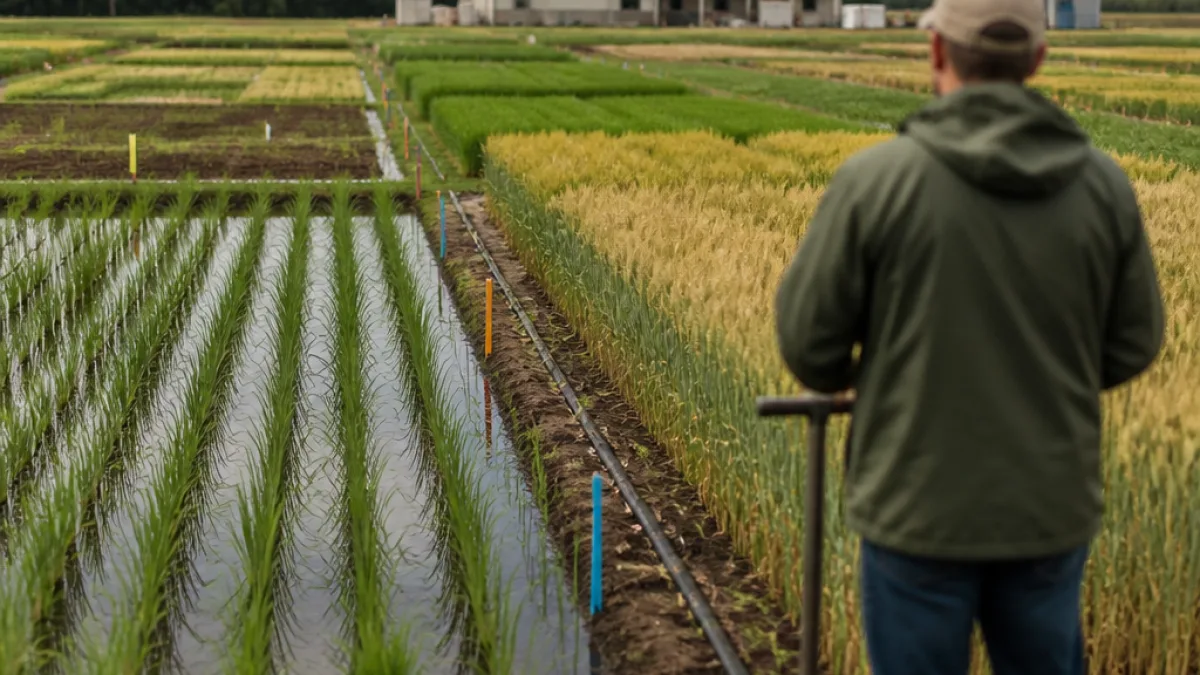
Researchers said the work will examine the fungi’s role in water uptake and nutrient acquisition and test whether inoculant formulations can improve drought tolerance in major cereal crops. The team will integrate laboratory experiments with genomic analyses to better understand fungus–plant interactions and evaluate candidate inoculants for use in rice and wheat production systems.
The NSF funding is intended to support multi-state research partnerships and infrastructure improvements that strengthen collaborative science across EPSCoR jurisdictions. Arkansas State’s lead role places the university at the center of efforts to translate fundamental mycorrhizal biology into potential seed or soil products aimed at increasing crop resilience to water stress.