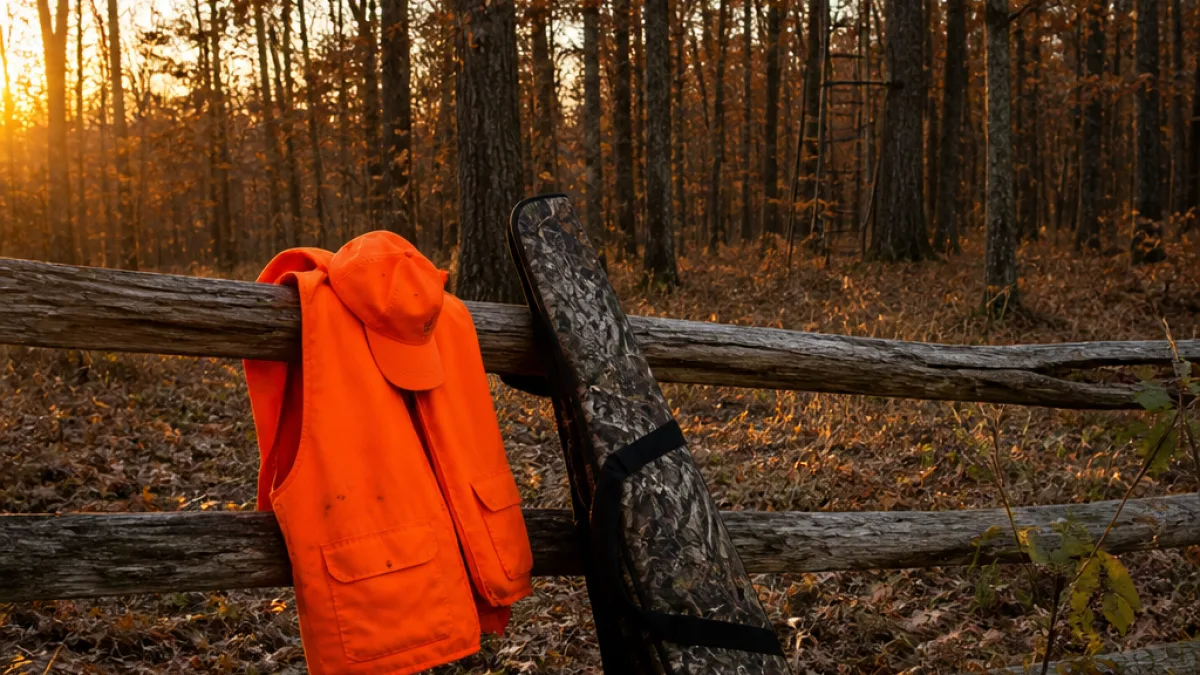
The Arkansas Game and Fish Commission’s rule requiring hunters to wear blaze orange for firearms deer seasons turns 50 in 2026. The regulation, first adopted in 1976, obliges hunters to wear at least 400 square inches of hunter orange and a matching head covering during firearms deer seasons, a safety standard that has become a fixture of Arkansas hunting.
Origins and expansion
The requirement was adopted by the commission in 1976 amid a broader national push for hunter visibility. Arkansas later extended blaze-orange rules to bear and elk seasons as those populations recovered enough to allow modern hunting seasons. Massachusetts was the first state to adopt a mandatory hunter-orange law in 1961.
“They have dichromatic vision, which means they only see blues, purples and greens well. Blaze orange that stands out to people is more muted to a deer. It's obviously not going to be the same color as your surroundings, but it actually blends in much better than bright green camouflage or blue jeans,” said Matt Gideon, hunter education and boater education coordinator for Game and Fish.
Gideon said hunters concerned that a solid block of orange might alert deer can choose garments printed in blaze camouflage. He called blaze camo a compromise that retains human visibility while breaking up a single-color silhouette.
- Requirement: 400 square inches of blaze orange plus a matching head cover for firearms deer seasons.
- Adopted: Arkansas Game and Fish Commission, 1976.
- Expanded: Later applied to bear and elk seasons as populations allowed modern hunting.
Safety context and hunter education
Hunter education in Arkansas did not become mandatory until 1985, nearly a decade after the blaze-orange rule took effect. Instructors and commission staff emphasize that blaze orange is primarily a visibility tool for people, not an attempt to alter how deer perceive color. Deer are more likely to detect movement than a single out-of-place color, officials say.
Officials recommend options for hunters who want to balance visibility with concealment from game, including:
- Blaze camouflage patterns that incorporate orange but break up a solid color block.
- Orange safety vests over hunting clothing to meet the 400-square-inch requirement while keeping usual camo or clothing underneath.
| Year | Event |
|---|---|
| 1961 | Massachusetts enacts the first mandatory hunter-orange law |
| 1976 | Arkansas Game and Fish Commission requires blaze orange for firearms deer seasons |
| 1985 | Hunter education becomes mandatory in Arkansas |
While some states still do not mandate hunter orange, Arkansas Game and Fish officials urge hunters to follow visibility practices during firearms seasons to reduce the risk of hunter-on-hunter incidents. The commission’s rule remains a simple, enforceable standard that field staff and law-enforcement partners continue to promote across the state.