Researchers at the University of Arkansas and the University of Michigan have reported a graphene-based device that harvests ambient electromagnetic radiation from standard 60 Hz power wiring and converts it into enough electricity to run an ultra-low-power temperature sensor without a battery, the team said.
how the device works
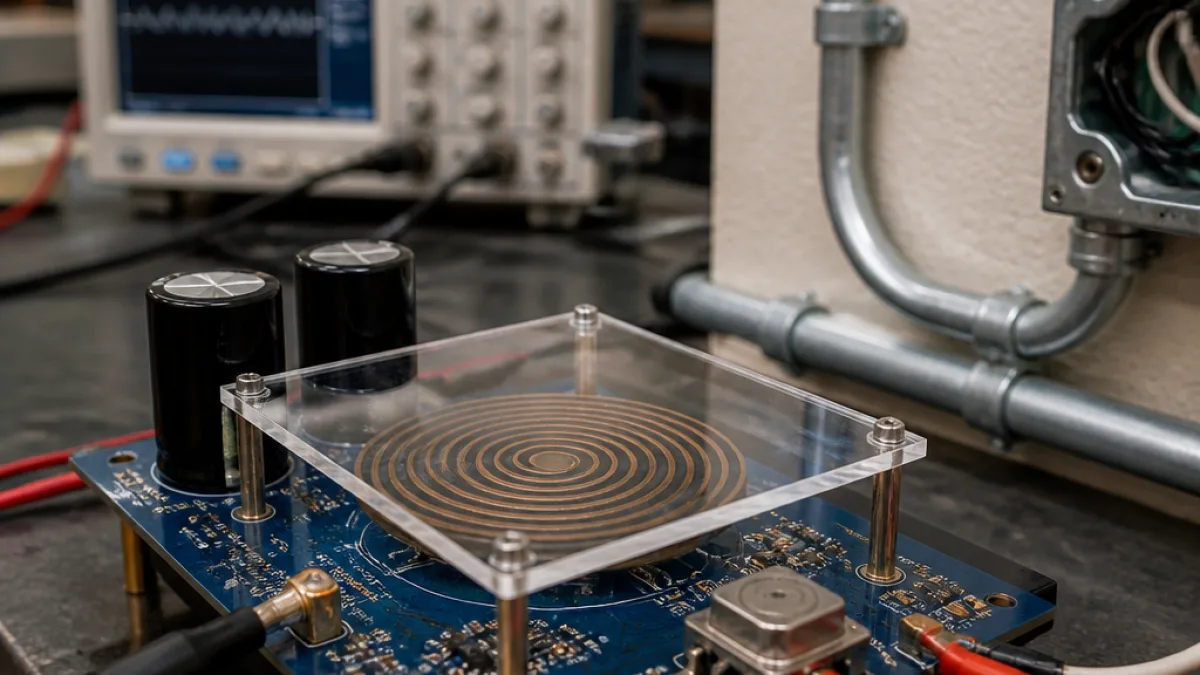
The paper, published in the Journal of Vacuum Science & Technology B, describes a system built around a graphene inductor that captures magnetic fields generated by nearby alternating-current wiring. The inductor feeds a custom circuit that rectifies the alternating signal and charges capacitors that power the sensor.
“The inductor adds charge to these capacitors at a slow rate, but it’s faster than the rate the sensor uses up the charges from the capacitors. So even if the power went out, it can still pull a charge from the capacitors. The way ours are set up, it can easily last 24 hours — probably a week even,” Paul Thibado, professor of physics at the University of Arkansas and corresponding author, said in the paper.
The researchers said the technology targets the 60 Hz frequency standard used in U.S. electrical systems and that its energy harvesting is complementary to other ambient sources such as light, thermal gradients, sound and motion. The team previously reported graphene-based solar cells capable of powering temperature sensors and described the current device as extending that approach to the electromagnetic fields that permeate buildings.
performance and context
Because building wiring is not arranged for energy capture, the researchers note that practical yields vary with wiring layout and proximity. The circuit’s charging behavior gives the sensor a reserve so it can continue to operate through interruptions in the ambient field. The paper emphasizes the device’s suitability for nanowatt-scale sensors and autonomous monitoring systems that must operate without regular battery maintenance.
- Graphene inductor harvests magnetic fields from nearby AC wiring at 60 Hz.
- The energy is converted to direct current and stored on capacitors to run an ultra-low-power temperature sensor.
- The system can sustain sensor operation during interruptions and may last 24 hours to about a week on stored charge, according to the researchers.
The research team said the work advances a broader goal of building autonomous sensor systems that draw energy from multiple ambient sources, reducing reliance on batteries for long-term deployments in buildings, infrastructure monitoring and other applications where wiring proximity makes harvesting feasible.
The study was carried out jointly by researchers at the University of Arkansas and the University of Michigan and appears in the Journal of Vacuum Science & Technology B. The paper includes experimental results and circuit design details intended for the scientific community and engineers working on ultra-low-power electronics.