Researchers with the University of Arkansas Division of Agriculture and the U.S. Department of Agriculture’s Agricultural Research Service are testing a low-cost mineral material as a possible addition to soybean pest management in the Mississippi Delta.
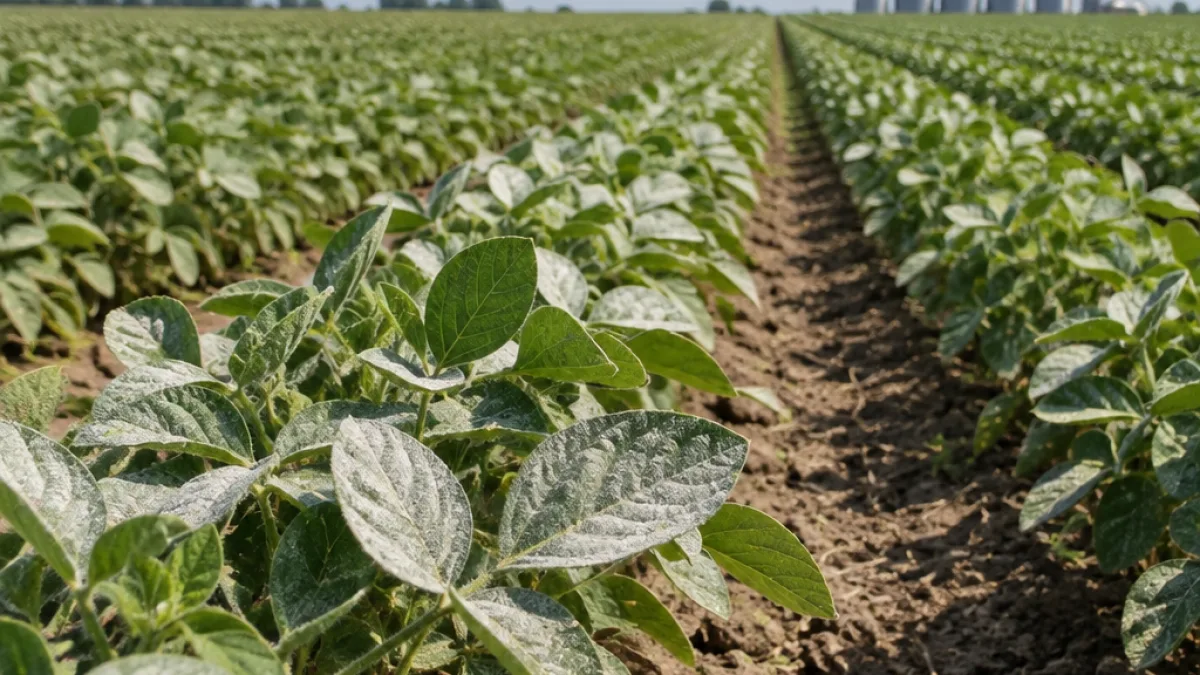
Two studies found that kaolin clay, mixed with water and sprayed onto soybean plants as a thin layer of particles, affected insect behavior and helped protect plants from heat stress. The work examined whether a material commonly used in Florida citrus orchards could also be useful in a row-crop system.
Studies examined pests and plant performance
The research was led in collaboration with the Arkansas Agricultural Experiment Station and the USDA-ARS Southern Insect Management Research Unit in Stoneville, Mississippi. Justin George, a USDA-ARS research entomologist and the corresponding author of both studies, said the researchers wanted to measure the clay’s effects on insects, pest numbers and soybean physiology.
“We knew kaolin worked well in other cropping systems, but we had never really studied it in row crops such as soybean.” — Justin George, USDA-ARS research entomologist
The first study, published in June in Pest Management Science, focused on how the particle film influenced egg-laying, feeding and insect development. The researchers studied soybean looper moths and southern green stink bugs, which damage soybeans in different ways.
Adult soybean looper moths were less likely to lay eggs on treated leaves. When eggs were laid, the young larvae had difficulty feeding and developing on the clay-covered surfaces. Results for southern green stink bugs differed, according to Rupesh Kariyat, a co-author of the studies.
Field work tested economic effects
A second study, published in July in Field Crops Research, moved the work into field plots. Researchers evaluated pest populations, plant performance and the economic effects of applying kaolin to soybeans. The field study also examined the material’s role in reducing heat stress on plants.
- The studies tested kaolin as a particle film on soybean leaves.
- Looper moths avoided treated leaves and their young had difficulty feeding on them.
- Field plots were evaluated for pests, plant performance and economic effects.
The findings place kaolin within an integrated pest management approach rather than presenting it as a replacement for every other control method. The research team’s work addressed whether a treatment already used in perennial crops could fit a Mississippi Delta soybean system, where pest pressure and summer heat affect plant development.